
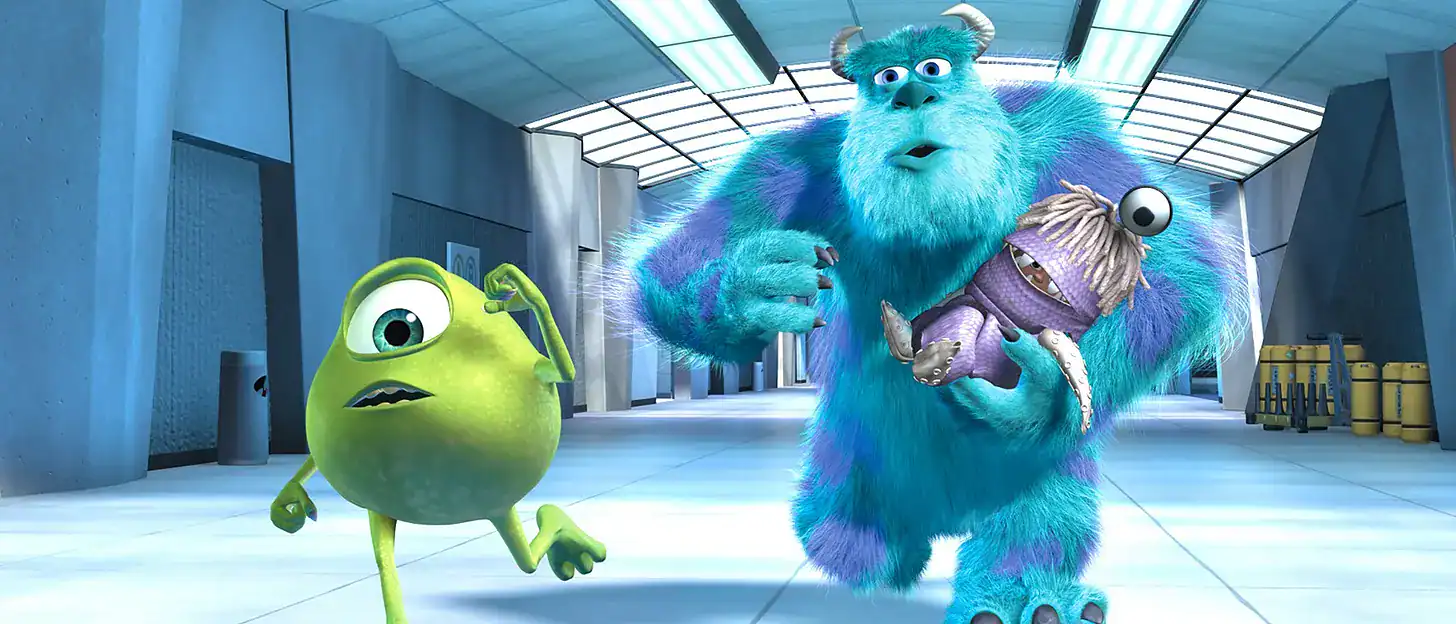
It had been at least ten years since I’d thought about the 2001 Pixar movie Monsters Inc.
Last week I was sitting in a coffee shop, turning over an idea I’d been circling for weeks: the possibility that human thoughts and emotion might be a kind of energy, and that something, somewhere, might be in the business of harvesting it. There’s a name for that idea, and I’ll get to it.
That was the thought in my head when, out of nowhere, the film surfaced. My daughter loved it when she was small. We must have watched it a hundred times, and then, the way these things go, it slipped under the surface of memory and stayed there for quite some time. But there it was again, fully formed, because it was suddenly, obviously about the very thing I was thinking about.
A few minutes later I got up to look for the restroom, and there, on a shelf at the back of the shop, sat a figurine of one of the characters from the movie. I laughed out loud. And before you reach for the tidy explanation, no, my subconscious had not caught a glimpse of it earlier and fed it back to me. The shelf was tucked at the back near the restrooms, nowhere I had walked or looked since coming in. The first time I laid eyes on it was moments after the thought had crossed my mind. (Figurine was Mike Wazowski.)
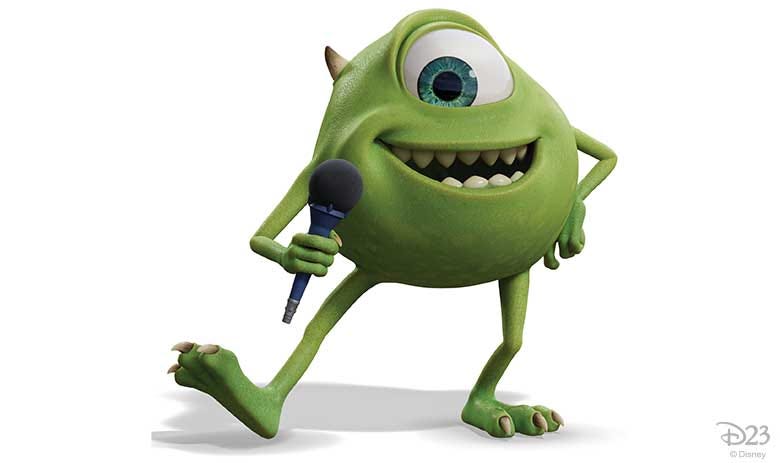
MikeWazowski
After seeing the character on the shelf I knew immediately I was going to explore this subject further. So let me follow the thread, because the film turns out to be a near-perfect parable for what I have been studying recently.
Fear As Energy
If you’ve forgotten the premise of the movie, here it is. There’s a city, Monstropolis, and it runs on a power plant. The plant doesn’t burn coal or split atoms. It harvests the screams of human children. Elite “scarers” step through closet doors into kids’ bedrooms at night, frighten them, and the screams are captured in canisters and converted into the energy that lights the entire city.
There is, of course, an energy crisis. Kids today are harder to scare. The canisters run low. The whole economy depends on a steady supply of childhood terror, and the supply is failing.
I’ll save the ending, because that’s the part worth waiting for. For now just stay with the premise: a children’s movie, made by one of the biggest entertainment companies in the world, opens on a whole civilization that keeps its lights on by scaring kids in their beds at night and bottling what comes out of them.
For context, I’d spent the previous few weeks buried in the life of Robert Monroe and the research coming out of the Monroe Institute. Just a coincidence, I’m sure.
Robert Monroe spent the better part of four decades documenting out-of-body states, and somewhere in the middle of that work he came back with a word he’d invented on purpose, to avoid the baggage of spirit or soul or chi. The word was loosh, and his account of it was this: living beings can emit a low frequency energy, and that energy is most concentrated under conditions of intense feeling, things like loneliness, fear, grief, and the desperation of a mother defending her young.
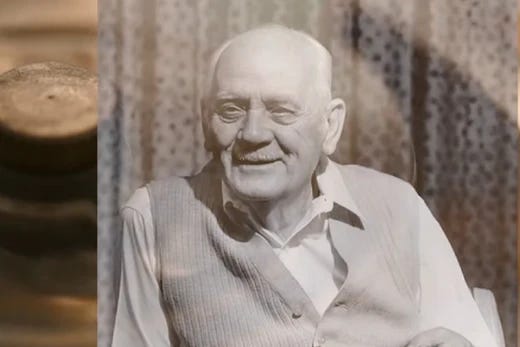
Robert Monroe
His most damning comparison was the dairy farm. The cows have grass, water, shelter. By every measure they can understand, they are well cared for, and most of them are content. They give milk their entire lives and never once suspect that the milk is the whole reason the place exists, that the farm was never built for them but for what can be extracted from them.
And we are the cows, he wrote. The grass and the water and the shelter are our paychecks and our screens, our comforts and our entertainments, everything engineered to keep us fed, distracted, and far too comfortable to ask what is quietly being drained out of us. The milk is the loosh.
And once you see the farm, you start seeing the milking everywhere, because the modern world is built to hold you in exactly the state that produces the most loosh. Turn on the news and you see it immediately: what is coming for you, what you should be afraid of tonight, what the other half of the country is about to do to your half. The news is not designed to inform you. It is designed to keep you in a constant state of vigilance and fear.
Politics has been reduced to a machine for manufacturing enemies, because a frightened, furious population is easy to move and impossible to satisfy. Entertainment rehearses apocalypse until the end of the world starts to feel like the only honest genre. And there is always, always a next thing to dread, the next war, the next collapse, the next pandemic, the next variant of the last fear, arriving on cue just as the previous one begins to lose its grip on you.
Even your own body gets turned into a source of dread, and it helps to be clear about why. A frightened person is a reliable customer. Whole industries have quietly organized themselves around keeping you a little worried about yourself, because worry sells.
Be afraid of your food and there is a cleanse, a supplement, a label that promises to save you. Be afraid of aging and there is a cream, a procedure, a clinic. Be afraid of your own moods and there is a questionnaire, a diagnosis, a prescription waiting at the end of it. Be afraid of your children’s ordinary struggles, the daydreaming, the restlessness, the rough year, and there is an evaluation and a specialist and a pill.
So far this is all darkness, the scream and the farm and the cows who think the barn was built for them. But Monroe did not stop at the farm, and neither did the movie. Both of them found the way out, and it turned out to be the same one. Hold that thought, because it’s the whole point.
Love As Energy
At the Monroe Institute in rural Virginia, Monroe and the researchers he worked with, among them the parapsychologist Charles Tart of UC Davis, developed an audio method he called Hemi-Sync, built on the idea that feeding slightly different tones into each ear could nudge the brain toward particular states more or less on demand. The aim was to make these out-of-body states repeatable, something a person could reach deliberately rather than stumble into, and over the years the Institute trained tens of thousands of people to do exactly that.
And the picture Monroe brought back, after all those years of exploring it, was not a horror story. It was closer to a school. We came to this place, Monroe believed, the way a student enrolls in a hard course, voluntarily, to learn something that can only be learned here.
And the thing it came to learn is the one thing the farm can neither manufacture nor steal. The entire painful curriculum, the fear and the grief and the loss, exists to produce beings capable of generating the highest frequency there is, which is love. Pain is the boot camp. Love is the diploma. The harvest is real, but it is not the deepest purpose of the place.
Here is the mechanism, and it may be the most important sentence in this article. When you operate from love, the lower frequencies cannot reach you. You stop emitting the thing the system eats. In Monroe’s framing you go dark to it, off the menu, invisible, because the intelligence that lives on fear simply cannot perceive a person who is not afraid.
This is not a new idea. It is the oldest one we have. Perfect love casts out fear, said the letter of John. The unshakeable mind, said the Buddhists. Monroe went somewhere, looked around, and filed it under physics.
There is a second piece, and it is the hinge of everything. Monroe found that reality organizes itself around belief, that what consciousness expects, it tends to meet. Decades later the channeled writer Paul Selig would describe the same thing as an agreement field: what enough of us hold in common, at a given frequency, hardens into the world we then live in. Which means the farm is not only done to us. It is, in part, agreed to, sustained by a frightened population that keeps broadcasting fear and so keeps building the very thing it fears. And anything we are agreeing to, we can stop agreeing to.
Now the ending I made you wait for.
Monsters, Inc. does not stay on the scream floor. Halfway through, the company trips over a discovery that breaks its entire economy: a child’s laughter generates many times more power than a scream. Not slightly more. An order of magnitude more.
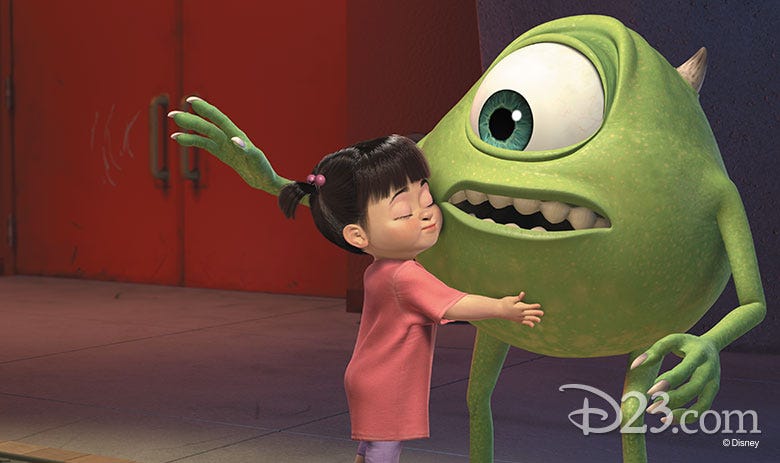
By the final scene the scream floor is gone, retooled into a laugh floor, the same plant drawing more energy out of joy than it ever wrung out of terror. And the little girl, Boo, the one they were harvesting, simply stops being afraid of the monster. Once she is not producing screams, the whole apparatus built on her fear has to be rebuilt around something else. She does not storm the plant. She does not defeat anyone. She just stops feeding it, and laughs.
A children’s movie, made by one of the most powerful entertainment corporations on Earth, takes its dystopia all the way down to the canisters and the closet doors, and then lands on precisely Monroe’s conclusion.
Fear is harvestable.
Love is the stronger current.
Where attention goes, energy flows. We are at a genuinely strange moment in human development, the first era in which capturing human attention, at scale and in real time, is among the most profitable activities on the planet. Whatever you think loosh is, the competition for your inner life is no longer a dystopian novel.
So what do you actually do, on a random Thursday, with all of this?
Not fight. That is the first and least intuitive part. Fighting the scream floor keeps your attention bolted to it, and your attention is the fuel. Resistance broadcast at the frequency of rage and fear is just more milk with a defiant label on it. The move is quieter and harder: change what you are broadcasting, and change where you point your attention, because that is the one lever you actually hold.
In practice it is almost embarrassingly ordinary. Less fear-media, more real food. More sleep, more time outside, more faces you can actually see. Have more fun. Build something with your kids instead of watching the horror feed with them in the next room. Make gratitude the default rather than the exception, not as denial of what is wrong, but as a deliberate choice of frequency.
None of it is exotic.
It is the daily, unglamorous work of refusing to be the scream.
The monsters figured it out in the end. Love was simply the stronger current.
This is your super power. Love over fear.
There is more of us than them.