
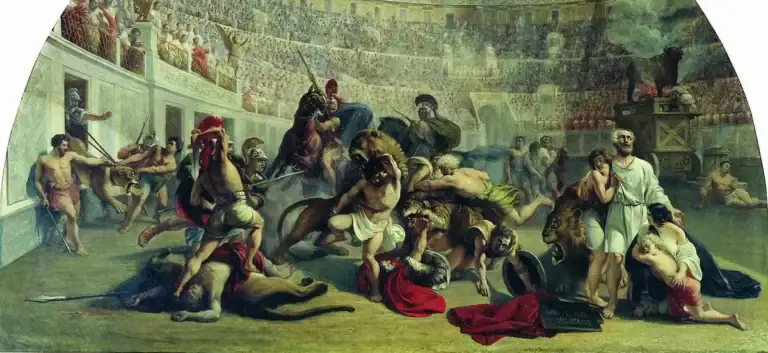
More than 1600 years ago, St. Augustine wrote of Alypius, a young man whose friends convinced him to attend the gladiatorial games in Rome. Opposed to bloodsport and disgusted by the spectacle, Alypius nevertheless was pressured into attendance. He resolved to keep his eyes closed, but when a gladiator fell, the deafening roar of the crowd piqued Alypius’ curiosity. He opened his eyes and beheld the carnage unfolding before him in the arena. He was swept up in the crowd’s bloodlust and began to cheer for death.
To St. Augustine, the injury to the young man’s soul was severe, even deeper than the physical wound suffered by the fallen gladiator. In choosing to witness death as a spectacle, he had corrupted his heart. Alypius began the day morally opposed to violence and ended it craving more.
On October 8th, the Pentagon announced plans to livestream the December 3rd execution by firing squad of Nidal Malik Hasan, the former Army psychiatrist convicted of murdering 13 people and wounding 32 others at Fort Hood in 2009. Secretary of War Pete Hegseth defended the decision, saying people need to understand the consequences of such crimes. President Trump initially expressed support for the livestream, but has since canceled the broadcast of the execution. However, the execution itself is still scheduled to be carried out.
The murders at Fort Hood were horrific. Families lost beloved sons, daughters, fathers and mothers. Others suffered brutal injuries that changed their lives forever. Hasan must account for the carnage he has caused and society must be protected from any further harm. But I do not believe deliberately taking another human life is an acceptable expression of justice, and I was even more troubled by the prospect of our government inviting Americans to gather around their screens to watch it happen.
I am sure many who would have tuned in to watch the execution would have believed they were taking part in the service of justice. Others might have been curious. Undoubtedly, some would have been excited to witness a man they despise being put to death.
The last motive concerns me most – but I believe all who would choose to witness a human being torn apart by bullets would have suffered a moral injury that we should not easily dismiss.
What concerns me most is the ease with which our hatred becomes justified when we share it with others. The crowd can make cruelty feel righteous to people who would otherwise recoil from it. We must remember, however, that our hatred does not become righteous simply because we direct it toward someone who has committed an unspeakable crime: it is simply more socially acceptable to despise someone when the crowd tells us that they deserve it.
Much like St. Augustine, the Stoic philosopher Seneca worried about the impact Ancient Rome’s gladiatorial games had on spectators. Writing in his seventh letter to Lucilius, he described attending the games and returning home feeling more cruel and less humane. He recognized how easily vice could enter through the pleasure of watching another person’s suffering, and knew the moral fabric of a society shreds when it allows carnage to become entertainment.
Rome was hardly unique. For centuries, public hangings were a familiar feature of British life. London’s Tyburn gallows drew enormous crowds, sometimes numbering in the tens of thousands. Vendors sold food and drink, spectators paid for desirable viewing positions, and printed accounts of the condemned became popular commodities.
In 1849, Charles Dickens attended the public hanging of Frederick and Maria Manning outside Horsemonger Lane Gaol. He was so disturbed by the behavior of the spectators that he wrote to The Times, expressing horror at the atmosphere surrounding the execution. By the 1860s, members of Parliament were questioning whether public hangings had hardened the population rather than discouraged crime. Britain abolished public executions in 1868.
America has its own history of such spectacles. In 1936, thousands gathered in Owensboro, Kentucky, to witness the hanging of Rainey Bethea. The event drew national attention, in part because of the carnival-like atmosphere surrounding it. The execution had become a public attraction, with spectators gathering to watch another human being put to death. Meanwhile, in 1928, New York executed Ruth Snyder by electric chair at the infamous Sing Sing Prison. A journalist from the New York Daily News smuggled a camera into the viewing room, and the next morning, the paper ran a photograph taken at the moment of her death. Some bought the paper out of a macabre sense of curiosity; others saw the grotesque image and felt the horror in their guts. To this day, it remains one of the most notorious photographs in American journalistic history, and raised serious questions about the commercialization of human suffering and whether curiosity justifies displaying a human being’s demise.
Nearly a century later, the Pentagon was prepared to revive the spectacle on a scale unimaginable to earlier generations, with technology capable of delivering an execution into millions of homes. Had the plan proceeded, the videos and images could have circulated indefinitely, reaching people who never intended to watch.
Consciousness extends beyond our physical experiences. Our thoughts, emotions, and intentions have spiritual significance, shaping our inner lives and influencing the world we create together. That which we allow to take root in our hearts becomes part of who we are.
I believe the bloodlust that leads someone to celebrate another person’s death carries the same destructive spiritual frequency as the hatred that can drive someone to murder. No, the spectator and the murderer are not morally equivalent; their actions and consequences differ profoundly. But the emotion of hatred remains the same.
The teachings of Jesus went even further. In the Sermon on the Mount, he taught that murder begins in the heart, and challenged his followers to examine the anger and contempt they harbored toward others. The First Epistle of John makes the connection even more explicit: “Whosoever hateth his brother is a murderer.”
These teachings require us to confront something uncomfortable about ourselves. We may condemn violence while quietly cultivating the very emotions from which violence arises. Jesus suggested we should take this far more seriously than we do.
Lest we forget, Jesus himself was no stranger to public executions – he suffered it himself. Crucifixion was a public execution, torture, and humiliation of the highest degree. The Gospel accounts describe a crowd watching his death, many jeering and mocking him. Yet Jesus’ response was to turn his attention to redemption. Beside him hung a thief, found guilty and condemned to die. Yet Jesus saw the man’s soul rather than his sins and left room for transformation. Likewise, he did not direct hatred towards those who killed him: instead, his words were “Father, forgive them, for they know not what they do.”
In another moment, he intervened to stop an execution. A woman accused of adultery was brought before Jesus in a public gathering, where her accusers invoked the law of Moses and demanded that she be stoned. Stoning was a communal punishment in which people could participate directly by throwing stones. Addressing the angry crowd, Jesus declared, “Let any one of you who is without sin be the first to throw a stone at her.”. Slowly the mob dissipated. To the woman he had just spared, Jesus said simply, “Go and sin no more.” He did not need to settle the accusation to stop the threatened execution.
But perhaps the more profound lesson was directed at the men who came to condemn her. They believed they were acting righteously, with the authority of religious law behind them. Jesus asked them to examine their own hearts before casting judgment upon hers. The woman was offered the chance to change her life, and her accusers were given that same opportunity.
I wonder how many people who invoke the teachings of Jesus to guide their moral lives have considered what these moments might ask of us today.
Unsurprisingly, the Pentagon’s justification for the proposed broadcast was that it would deter other such crimes. Research offers no reliable basis for that confidence. In 2012, the National Research Council of the National Academies reviewed decades of research on capital punishment and homicide; the researchers concluded that existing studies could not reliably establish whether executions reduce murders, increase them, or have no meaningful effect on homicide rates. The National Institute of Justice has found that, for crime more generally, the likelihood of getting caught is a stronger deterrent than the severity of punishment. That research does not establish that broadcasting an execution would prevent violence. There was little reason to believe that sending the images of a human dying into millions of homes would prevent further violence – in fact, I would argue the opposite. Hasan reportedly believed his execution would make him a martyr. Timothy McVeigh, the Oklahoma City bomber, even requested that his own execution be televised nationally. The government refused. Why would we assume that execution would deter someone who regards death in service of his ideology as a spiritual victory, and that it would not inspire others with a distorted belief system who long for the apparent significance of notoriety?
For me, the larger question remains whether we should be willing to take another human life at all.
I oppose the intentional taking of human life under any circumstances. True redemption must remain possible for every soul. Human beings are capable of profound change – history is filled with such examples, including the Apostle Paul, who went from persecuting Christians and approving their executions to becoming a leader in the early Church. Such transformations are neither guaranteed nor easily measured. I have no way of knowing whether Hasan will ever experience remorse. He may remain committed to the worldview that led him to murder innocent people. But our inability to imagine another person’s transformation does not give us the moral authority to extinguish his life.
When Abraham Lincoln appealed to the “better angels of our nature” in his first inaugural address, he was speaking to a nation approaching civil war. His words expressed a hope that the bonds connecting Americans might prove stronger than the hatred pulling them apart. His appeal remains relevant today. We live in a culture where contempt is rewarded, public humiliation has become entertainment, and the suffering of people we regard as enemies can be met with extraordinary indifference. Technology has made it easier to indulge our anger while distancing ourselves from its consequences.
The Pentagon’s proposed broadcast brought that tendency to a disturbing new place. It would have invited millions of people to witness a deliberate killing, including those who regard the condemned man’s death as a source of satisfaction.
And I think of the crowd gathered around the woman accused of adultery. Those who arrived prepared to kill were given an opportunity to examine their own hearts. They could have carried out the sentence, confident that the law justified their actions. Instead, they walked away. The condemned woman was given the opportunity to live a different life. But she was not the only person offered the possibility of transformation. The men who gathered to condemn her were invited to recognize their own capacity for cruelty and choose not to act upon it.
We cannot undo the murders at Fort Hood or restore the lives that were lost. We can, however, refuse to answer that suffering by nurturing more hatred within ourselves. We can insist upon accountability without abandoning the possibility of forgiveness, and we can recognize the humanity of someone whose actions we unequivocally condemn.
I am grateful President Trump canceled the broadcast. I hope he will reconsider the execution itself. But whatever the government decides, each of us remains responsible for what we choose to participate in.
Perhaps the greatest danger in making an execution a public spectacle is that we become so certain of another man’s evil that we no longer recognize the hatred growing in our own hearts. For the sake of our country, and for the sake of our souls, I pray we find the courage to set down the stones.