
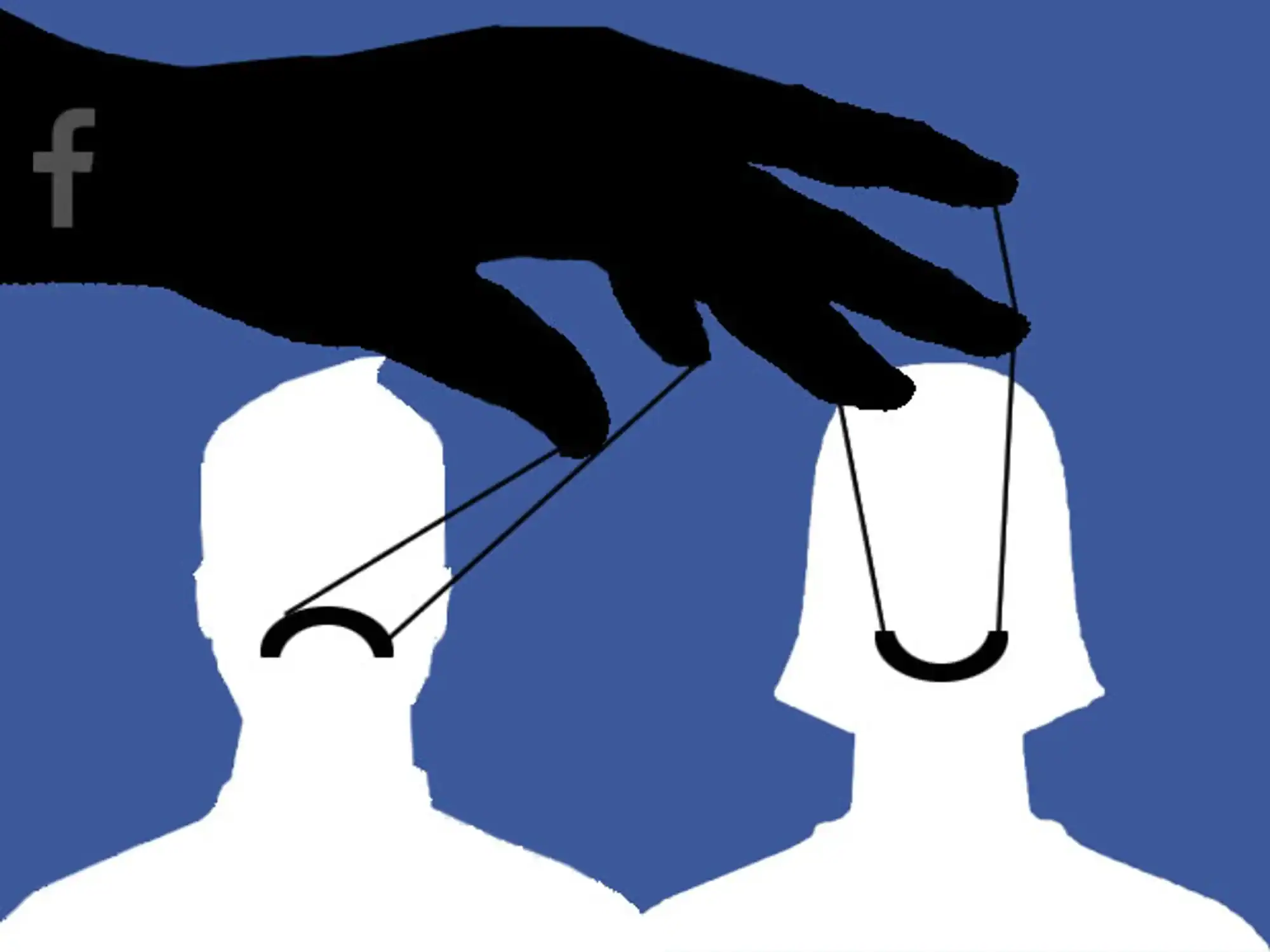
Most of us would say we know our own minds. We wake up in a mood and call it ours. We form an opinion and defend it as though we constructed it ourselves. For most of my career as a clinical psychologist, I assumed the inner lives people described to me originated inside them. Two bodies of research have forced me to reconsider that.
One shows that a technology company can change how millions of people feel without their knowledge. The other shows that the order of a list can change what millions of people believe. Together they describe a system that shapes the emotional state you are in and then supplies the conclusions you will accept while you are in it. The studies are the easy part. What they mean for us is where I want to spend our time.
For one week in January 2012, Facebook altered the feeds of 689,003 users without telling them. One group saw fewer positive posts from friends, another saw fewer negative ones. The results, published in 2014 in the Proceedings of the National Academy of Sciences, showed that people shown less positivity began posting more negatively, and the reverse was also true. Their moods had been adjusted from the outside, and their own words carried the adjustment to everyone they knew.
Facebook defended the study by pointing to its terms of service, but journalists found that the word research was added to that policy four months after the experiment ended. In my field, altering the emotional environment of nearly 700,000 people without consent would have violated ethics and law.
Critics noted that the effect on any one person was tiny, and I believe they meant this as reassurance. I read it as the most important finding in the paper. A nudge too small to notice, delivered daily to billions of people, is the most efficient form of influence ever devised, precisely because no one feels it.
Now that small nudge is repeated, over and over again.
When Your Mood Is Not Your Own
We treat our emotions as private internal events and many people build identities around them. For example, “I am an anxious person” or “I suffer from depression”. The Facebook study quietly dismantles that model. If a week of altered posts can shift the emotional tone of 700,000 people, then a meaningful portion of what any of us feels on a given day may have been delivered rather than generated.
That matters more than it first appears. Psychologists have long documented mood-congruent memory, our tendency to recall events that match how we feel right now. A person in a low state remembers failures and betrayals vividly while the good years go dim. So a mood that arrives through a screen does not stay a passing mood. It reaches back and edits the story you tell about your own life, and with enough repetition that story becomes your sense of self.
I saw where it ends up.
For years people came into my office describing a heaviness that nothing in their marriage, work, or health could explain. Many spent hours a day inside these feeds. The system they walked into had no understanding for an engineered mood, only for disorder. A questionnaire was completed, a label assigned, and often a drug prescribed for a state that had been manufactured in a server farm. There was this assumption that our moods, without any particular event prompting them, must represent something biological. That is exactly why this is so serious.
When our signals are flooded with noise, we lose the ability to read the ones that matter. There is freedom in seeing this, though. If some of your heaviness did not originate with you, it is not a verdict on who you are. You are not your mood. You are the one who can notice it, ask where it came from, and decide whether to keep carrying it.
Outrage Is the Product
Once you know emotion can be steered, the question becomes which emotion a company would choose. We no longer have to guess. Internal documents released by former Facebook employee Frances Haugen in 2021 showed that beginning in 2017, the platform’s ranking system counted an angry reaction as worth five times a like. Its own researchers warned that the system was rewarding outrage and division. The business model did not change, because anger keeps a person scrolling and scrolling is what is being sold.
A team at New York University found that each moral or emotional word in a political post, words like shame or evil, raised its chance of being shared by about 20 percent. The algorithm did not invent our tribal instincts. It found them, measured them, and learned to feed them and our children pay the steepest price.
Among the Haugen documents was Facebook’s own finding that Instagram made body image issues worse for one in three teenage girls and the company knew. Adolescence is when the brain becomes acutely sensitive to status and belonging, and that sensitivity once had limits because the school hallway stayed behind when a child went home. Now the hallway follows her into her bedroom, engineered by some of the most talented people in the world to keep her looking.
Think about the people you have disagreed with in recent years. Maybe it is a brother-in-law, an old friend from high school, or the neighbor across the street. Sit across a table from any of them and you would likely find a decent person, someone who would help push your car out of the snow or show up at your father’s funeral. Yet many of us have come to see entire categories of these same people as dangerous, foolish, or even evil.
That perception did not form at our dinner tables. It was cultivated by a feed that profits from contempt. The algorithm learned that the surest way to hold our attention was to show us the most extreme voice from the other side, a stranger we will never meet, at the precise moment we were most likely to react. Over time that stranger became the face of everyone who disagrees with us, including the people we love.
A divided people spend their energy on each other, policing opinions and cutting off family, while the decisions that shape their lives are made quietly elsewhere. Clinically, anger is usually a secondary emotion sitting on top of fear, hurt, or powerlessness. The feed supplies an enemy that makes a person feel strong for a moment, but it can never supply what they actually need, which is agency and connection in their real life. So the anger returns the next day, a little stronger.
The antidote is to notice when contempt arrives and ask a different question. Instead of asking what is wrong with that person, ask how a reasonable human being came to see the world that way. That single shift breaks the circuit. Whenever anyone tells you a whole group of people is unworthy of basic love and respect, you are being manipulated.
Fear contracts. Love expands.
The machine runs on the first and has no defense against the second.
The Top of the Page
If the feed works on how you feel, the search bar works on what you believe, with even less visibility.
Psychologist Robert Epstein named it the search engine manipulation effect. In experiments published in 2015 with more than 4,500 undecided voters in the United States and India, his team showed people search results ordered to favor one candidate. Nothing in the results was false. Only the order changed, and that alone shifted voting preferences by 20 percent or more. Almost no one noticed. They believed they had made up their own minds.

We are vulnerable because we have been conditioned and thousands of times we search for simple facts and the right answer sits at the top. Without ever deciding to, we learn that the top result is the true one. Then we search something uncertain, a drug, a candidate, a frightening diagnosis, and that trained trust comes with us. With Google handling roughly 90 percent of searches worldwide, there is essentially one list.
I lived this when I began writing publicly about SSRIs around 2018. Every time someone pushed back, they arrived with the first page of a search, WebMD and industry-friendly sources assuring them these drugs were safe and effective. They cited studies they had never opened. What struck me most was how certain they were. Researchers at Yale have shown that simply searching the internet makes people rate their own knowledge higher, even on topics they never looked up. We have outsourced our memory and kept the confidence. Artificial intelligence now delivers a single fluent answer with no list at all, and that fluency tells you nothing about who shaped it.
What It Means to Know Something
Having access to information is not the same as knowing something. Knowledge used to be earned. You read the whole book, sat with a teacher, tested an idea against your own experience, and something settled in you that you could stand on. What most of us have now is borrowed certainty, an answer arranged by someone we will never meet, carried with the confidence of an expert and none of the understanding. When it is challenged we cannot defend it from the inside, so we attack the person who questioned it.
This is how consensus is manufactured. No one has to lie outright. It only takes control over what appears first, what gets repeated, and what gets buried. A generation raised this way learns to treat agreement as evidence, and most will never know the difference.
What concerns me most is what happens to our inner authority. Each of us were born with discernment, a felt sense of when something is true and when something is off. Call it conscience, the still small voice, intuition or the higher self. It strengthens with use and weakens with neglect, and every question handed to a search bar before we ask ourselves what we think makes it a little quieter.
Put the two together and you see the loop. First you are brought into agitation, fear, or outrage. Then, in that state, you go looking for answers, and they are waiting for you in a predetermined order. You come away with a strong feeling and a confident opinion, and you believe both were your own.
The answer is not to throw your phone in a lake. It is becoming more conscious, the simple act of noticing what is being done while it is being done. Start with your emotions, because that is where the hook goes in. When nothing in your actual day justifies the heaviness or fury you feel, ask whether it arose from your life or was delivered to you. If it was delivered, you are free to set it down.
Then reclaim your discernment. Spend time each day in silence, without input, so your own thoughts have room to surface. Read the study instead of the headline. Seek out the strongest version of the view you oppose. Learn to say I don’t know yet. And protect your children alongside other parents rather than alone, because one family standing apart feels exposed while a handful standing together changes what is normal.
These companies know which emotion keeps you scrolling and which result you will trust. The one thing they cannot manufacture is your awareness. The moment you see the loop clearly, it begins to lose its grip. Where your attention goes, your life follows. Decide for yourself where that will be.
Sources
- Kramer, Guillory & Hancock (2014), Experimental evidence of massive-scale emotional contagion through social networks, PNAS
- Kashmir Hill (2014), Facebook added ‘research’ to user agreement 4 months after emotion manipulation study, Forbes
- Merrill & Oremus (2021), Five points for anger, one for a ‘like’: How Facebook’s formula fostered rage and misinformation, Washington Post
- Brady et al. (2017), Emotion shapes the diffusion of moralized content in social networks, PNAS
- Wells, Horwitz & Seetharaman (2021), Facebook knows Instagram is toxic for teen girls, company documents show, Wall Street Journal
- Epstein & Robertson (2015), The search engine manipulation effect (SEME) and its possible impact on the outcomes of elections, PNAS
- StatCounter, Search engine market share worldwide
- Fisher, Goddu & Keil (2015), Searching for explanations: How the Internet inflates estimates of internal knowledge, Journal of Experimental Psychology: General